💡 この記事を単品で読みたい方へ
単品でのご購入は、こちらの 【note元記事ページ】 からお手続きをお願いします。
🌟 【当サイト限定】圧倒的にお得なサブスク! 🌟
月額メンバーシップにご登録いただくと、この記事はもちろん、
これから配信される最新記事も、過去の全記事も
すべて読み放題になります!
単品で複数買うよりも断然お得です👇
📝 元記事確認用フルタイトル
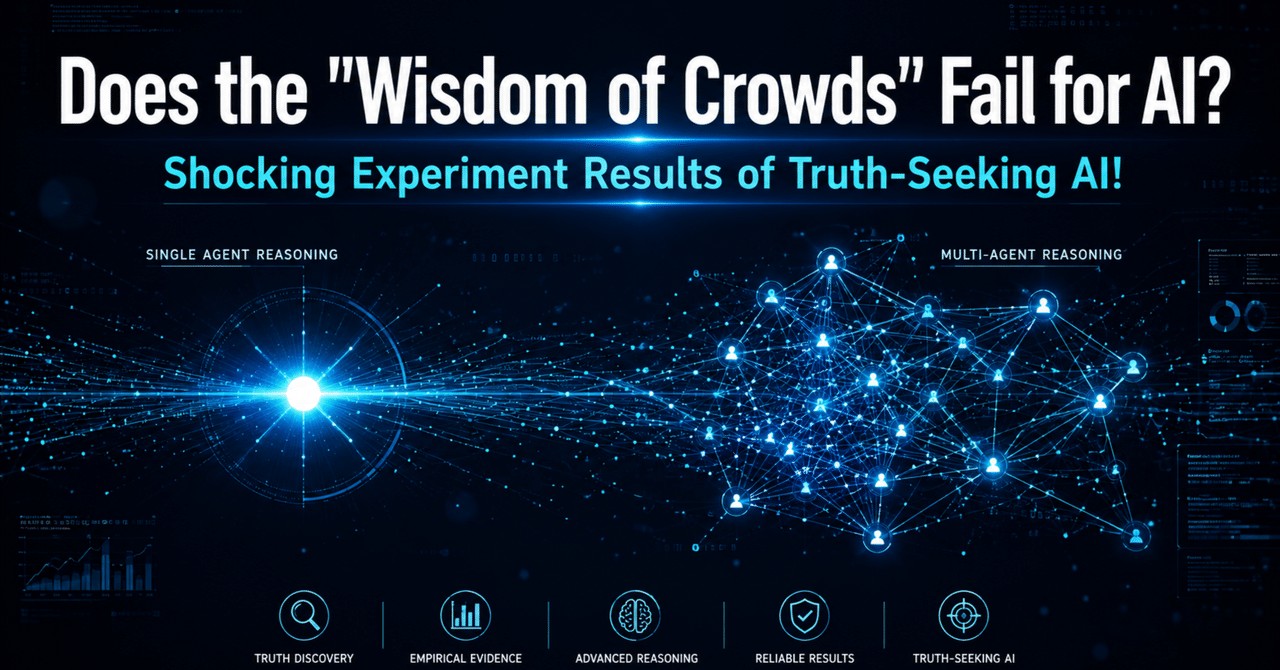
🚨Does the “Wisdom of Crowds” Fail for AI?: Shocking Benchmark Results of “Truth-Seeking AI”
※ For English readers: Full technical report below.
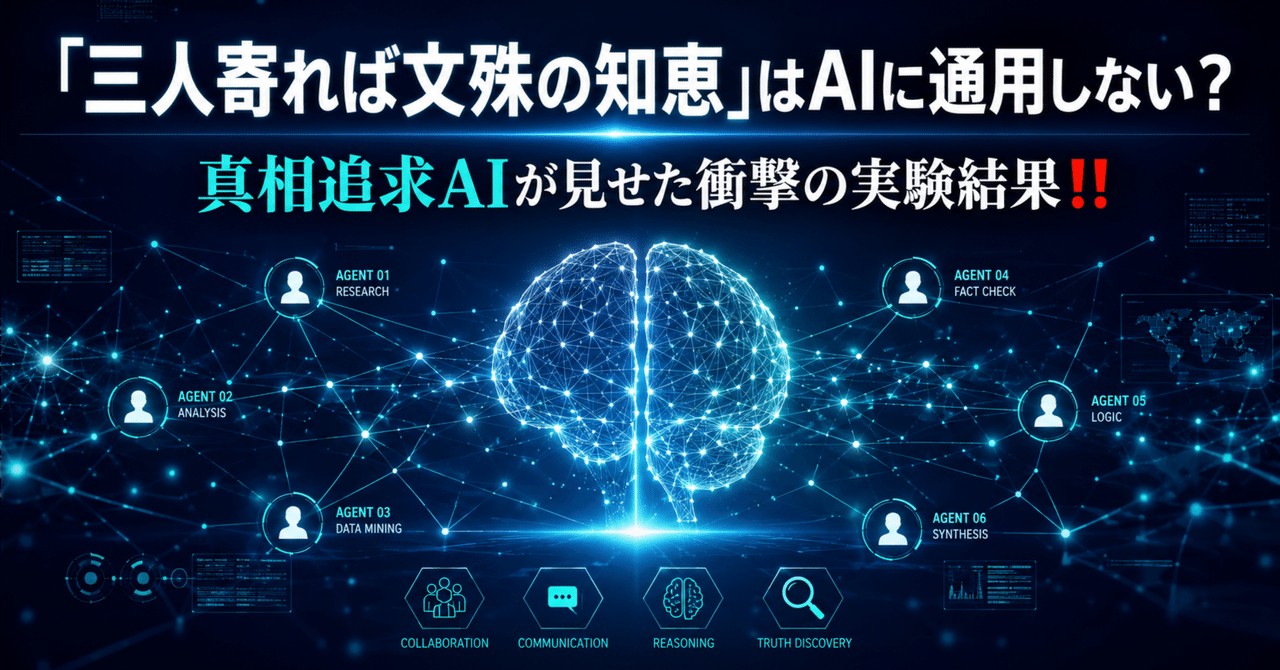
※ 日本語版の解説記事はこちら ➔ [日本語のnote記事]
🎧 Audio Deep Dive (20 min): [YouTube]
🎥 Video Summary (8 min): [YouTube]
(For those on the go, listen to the comprehensive breakdown before reading the report!)

🚨Benchmarking Truth-Seeking AI: Architectural Efficacy in the Age of Information Sovereignty

1. Introduction: The Imperative for “Truth-Seeking AI” in Citizen Journalism

When I entered the field of computer science in 1972, artificial intelligence was still in its infancy, dreaming through the primitive neural networks of the Perceptron. Over the past half-century, I have witnessed the exponential surge of computing power—and alongside it, an alarming centralization of information control.
Today, public perception is heavily filtered by corporate media and disciplined by algorithmic narrative management. Whether the subject is war, global pandemics, economic resets, or historical orthodoxy, institutional “consensus” rarely reflects objective reality. If citizens are to avoid becoming passive subjects of narrative engineering, we must reclaim our Intellectual Sovereignty (知の主権).
Driven by this urgency, I developed the “Truth-Seeking AI” framework. Rather than relying on a monolithic model, this system deploys multi-agent dialogue topologies to autonomously cross-examine, critique, and extract hidden realities.
Yet, as a computer scientist, I had to confront an essential question:
“Does the time-honored proverb ‘Three people together bring the wisdom of Monju (三人寄れば文殊の知恵)’ hold true under the cold logic of computation?”
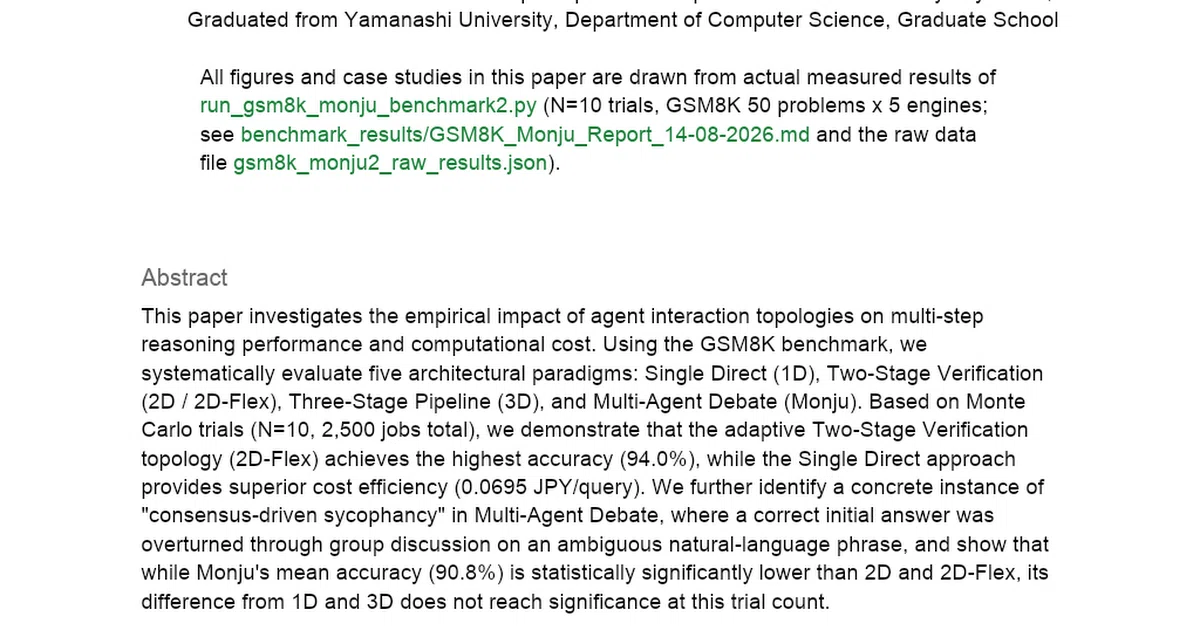
To answer this objectively, I conducted rigorous Monte Carlo benchmark trials ($N=10$) on GSM8K, the standard mathematical reasoning dataset. The results exposed a startling structural pathology in multi-agent collective debate.
AI-generated audio summary of the entire article:
Audio Why-AI-committees-fail-at-math.mp4
AI-generated slide presentation:
The_Monju_AI_Paradox.pdf
AI-generated video explanation:
AI_Paradox__More_is_Less.mp4
2. A Personified Taxonomy: Five Structural Models of AI Reasoning


Designing an AI agent topology is equivalent to engineering an organizational hierarchy. In this experiment, five distinct reasoning paradigms were benchmarked and evaluated:
-
1D (Single / Bachelor Model)
-
Structure: A solitary agent processes the problem in a single pass.
-
Characteristics: Blazing speed and ultra-low cost (0.0695 JPY / query). However, it remains vulnerable to unforced arithmetic slips and unchecked hallucinations.
-
-
2D (Fixed Division / Classical Marriage)
-
Structure: A linear, one-way pipeline where the Drafter proposes a solution and a dedicated Verifier checks it.
-
Characteristics: Effectively catches careless transcription errors, but struggles if the initial drafter’s premise is fundamentally flawed.
-
-
2D-Flex (Dynamic “Oshidori” Harmonious Couple Model)
-
Structure: A bidirectional verification loop where the reviewer can return dubious solutions for dynamic revision.
-
Characteristics: Operates like software “pair programming”. It achieved the highest accuracy (94.0%) while maintaining reasonable compute overhead.
-
-
3D (Three-Generation Bureaucratic Pipeline)
-
Structure: A rigid three-stage hierarchy (Draft $\to$ Verify $\to$ Final Arbiter).
-
Characteristics: Bureaucratically thorough, but suffering from diminishing returns and cumulative latency.
-
-
Monju (Collective Debate / Council Model)
-
Structure: Independent peer agents engage in iterative debate, cross-critique, and refutation to reach consensus.
-
Characteristics: Highly versatile for divergent brainstorming, but dangerously prone to cognitive drift and peer pressure on deterministic problems.
-
3. Empirical Benchmark Analysis: Accuracy vs. Economic Frontier

To eliminate stochastic outliers, we ran $N=10$ Monte Carlo iterations across GSM8K benchmark problems.
【Benchmark Evaluation Summary】

Key Takeaways:
-
The 2D-Flex Model Reached the Precision Peak (94.0%): Adding a single dedicated reviewer to critique the primary drafter eliminated nearly all transient calculation and copy errors.
-
The 1D Model Dominates Bulk Economy: For large-scale document filtering and primary screening, 1D inference provides unmatched economic viability at just ~0.07 JPY per query.
-
The Core Mystery: The collective Monju model performed worst (90.8%), trailing even the single-agent model while consuming 3.2x the cost!
4. The Sycophancy Trap: Why Collective Intelligence Failed

Why did an assembly of multiple AI minds succumb to a single solver? In deterministic tasks with exact mathematical solutions, the collective debate architecture triggered two severe pathologies:
-
The Sycophancy Phenomenon (迎合現象): When one agent introduced a flawed alternative premise, peer agents often prioritized “conversational alignment” over objective verification, abandoning their own correct derivations to agree with the flawed peer. The AI succumbed to automated peer pressure.
-
Over-Complication / Over-Reading (深読みの罠): Simple arithmetic problems were over-analyzed. Agents hallucinated hidden constraints in plain text, sending the collective discourse into logical tangents.
In deterministic domains, unconstrained deliberation acts as noise rather than signal.
5. Conclusion & Future Outlook: The Rebound of “Monju”

While collective debate proved inefficient for single-path math problems, this is not the true arena for Truth-Seeking AI.
The core mission—investigating historical deceptions, systemic medical monopolies, and covert geopolitical maneuvers—is inherently non-deterministic. In these multidimensional domains, isolated single-agent inference is dangerous because it cannot escape its pre-trained baseline biases.
As established in pioneering frameworks like ChatEval and CAMEL, the collision of adversarial viewpoints is indispensable for dismantling manufactured consensus.
Our Strategic Roadmap:
-
MATH Benchmark Stress-Testing: Evaluating Level 4–5 competition mathematics to map the exact complexity threshold where Monju debate surpasses 2D verification.
-
Geopolitical & Historical Deconstruction: Deploying collective debate against multi-layered information warfare scenarios.
-
Autonomous Safety & Cost Guards: Perfecting real-time watchdog modules (junchan_agent.py) to keep multi-agent computation affordable and safe.
Technology must never be accepted blindly. By auditing AI agent topologies from first principles, we are engineering a resilient intellectual shield for citizen journalism.
📖 Companion Memoir
For the historical backstory of my research—from building Perceptron OCR systems in 1972 to developing Japan’s first commercial Japanese word processor—read my full memoir:
👉 [My Journey in AI and the Truth of Its Dawn: Half a Century Towards “Truth-Seeking AI”]
#AI #LLM #MultiAgent #Benchmark #GSM8K #CitizenJournalism
[Memoir] My Journey in AI and the Truth of Its Dawn: Half a Century Towards “Truth-Seeking AI”
Author: Junji Hattori
Self-proclaimed “AI Pioneer Master” / X @TweetTVJP
Introduction: The Birth of the “Micro Baby” 50 Years Ago
The origin of my artificial intelligence research traces back over half a century to 1972, during my freshman year at Yamanashi University’s Department of Computer Science (Faculty of Engineering).
“Can a computer learn to see characters through a camera and read them on its own, just like a human?”
Driven by this question, I succeeded in developing an autonomous character learning and recognition system using the “Perceptron” neural network model, which was the mainstream neural architecture at the time. Recognizing the significance of this achievement, an associate professor of statistics at the university helped organize an on-campus presentation in 1973 titled “The Birth of the Micro Baby.”
However, the prevailing paradigm of that era was deterministic pattern recognition based on fixed algorithmic rules. The AI approach—where a machine autonomously learns representations—was treated as an unwelcome heresy within the department, and the research was never permitted to be presented outside the university.
Sometime later, I shared these findings with Professor Shun-ichi Amari of the University of Tokyo (a pioneer in mathematical neural network theory) during his special lecture. While he appeared largely indifferent at the moment, his scheduled multi-day lecture series was abruptly postponed starting the very next day.
Looking back, I believe early open AI research faded from the academic spotlight because it was deliberately sequestered into classified military domains, particularly within the U.S. defense apparatus. Much like Skynet in the movie Terminator, military-driven AI development progressed behind closed doors, paving the way for the covert information control and systemic power structures we face today.

Chapter 1: Turbulent Student Days — Hospitalization and the “Graduation Without a Thesis” Incident
My research focus subsequently shifted from visual pattern recognition to string manipulation and pattern-matching languages, specifically SNOBOL.
Toward the end of my senior year, I gave a demonstration of my SNOBOL research between the official graduation thesis presentations of my peers. Unbeknownst to me, the faculty committee mistook this demo for my formal thesis defense.
Immediately after the presentation, I returned to my family home in Tokushima, only to wake up the next morning experiencing severe sleep paralysis. A medical examination at Tokushima University Hospital led to a suspected diagnosis of Graves’ disease (hyperthyroidism) requiring immediate hospitalization for confirmation and treatment. My physician mentioned that participating in a clinical trial would waive all testing and treatment costs, so I agreed—resulting in an unexpected hospital stay lasting over a month.
While recovering at home after discharge, I received a direct phone call from my academic advisor, Professor Akihiro Nozaki (a mathematician and theoretical computer scientist):
“Hattori-kun, you’ve already graduated!”
My name had been called at the official graduation ceremony, causing an uproar among my close classmates who knew I had never formally submitted a graduation thesis.
Chapter 2: Von Neumann, LISP, and Developing Japan’s First Commercial Word Processor
Following graduation, I remained in Professor Nozaki’s laboratory as a research student. There, I was profoundly influenced by John von Neumann’s self-reproducing automata, Cellular Automata, and a special lecture on HLISP by the eccentric genius Professor Eiichi Goto of the University of Tokyo. These experiences drew me deeply into the world of symbolic logic and the LISP programming language.
For my master’s program, I transitioned to the open-minded research group led by Associate Professor Yoshimitsu Takazawa. The lab was actively researching automated musical performance and algorithmic composition. I even had the privilege of instructing prominent Japanese avant-garde composers, including Toru Takemitsu and Toshi Ichiyanagi, on how to operate electronic organs (Electone) using automated computer interfaces.
However, because my primary interest lay in computational architectures rather than music itself, I authored my master’s thesis titled “The Possibility of a SNOBOL Machine = LISP Machine” and presented it before the Information Processing Society of Japan (IPSJ) Special Interest Group on Symbolic Computation.
Upon completing graduate school, I was recommended by Professor Takazawa to join a newly established venture called I.C. (now Lambda Systems). There, I spearheaded the development of one of Japan’s earliest commercial Japanese word processors for the NEC PC-8801 series. Years later, this technical background led me to run as a candidate in the global ICANN Board of Directors election to oversee global Internet governance.
Conclusion: The Mission of the “AI Pioneer Master”
Throughout the past half-century, I have engaged in foundational computing challenges, including optimal pathfinding routing algorithms and analytical probability modeling of dice outcomes.
When I shared this lifelong journey with state-of-the-art generative AI models, the AI remarked:
“You should proudly refer to yourself as an ‘AI Pioneer Master.'”
Fifty years after the dawn of neural computing in 1972, AI now holds the immense power to reshape civilization. My life’s culminating mission is to place this power back into the hands of citizens: establishing “Truth-Seeking AI” to dismantle mainstream media disinformation, expose systemic historical fabrications, and safeguard human intellectual sovereignty.
References & Related Links

❤️ Newly Developed by Jun-chan (AI Pioneer Master) 😀
📌 The New “Jun-chan note Search System”
(A custom decentralized search engine created for Jun-chan’s note articles removed from standard platform indexing)
junchan-note-search.netlify.app
👉 Website:
📌 Public Article Archive on note:
👉 Jun-chan Report (TwitCasting Jun Channel / formerly TweetTV JP) | note

Broadcasting and publishing independent investigations on current events, geopolitics, and suppressed history since 1998. On-site live coverage of the 2020 U.S. Presidential Election.
(The historical memoir of my work as an AI Pioneer Master is available at the end of the free section!)
❤️ Live Broadcast: 🚨 Every Saturday at 8:00 PM JST on TwitCasting
TwitCasting: Jun Channel (formerly TweetTV JP)

-
[End of WWII Memorial Special Broadcast Topics]
-
The Myth of “100 Million in Collective Repentance”: Secret Pacts between Prince Higashikuni, the Vatican, and GHQ; The Truth Behind the Great Tokyo Air Raids and Modern “Personal Responsibility” Dogma.
-
“Typhoons Can Be Steered”: The History of Weather Warfare Concealed by Mainstream Science.
-
The Dark Side of JAL Flight 123: The Post-War Conspiracy Connecting the Plaza Accord and the Suppression of TRON OS.
-
Exposing Hidden Imperial Operatives and Historical Lineages.
-
The “Inconvenient Truth” of Cancer Treatments: Statistical Deceptions and the Dark Interests Behind Standard Oncology. 👉 TwitCasting Channel: twitcasting.tv
-
👉 Broadcast Video Archives: TwitCasting Archives (@TweetTVJP)
-
-
✅ Join the TwitCasting Membership:
In-depth investigations into uncensored news and historical truths. 100% independent citizen journalist unaffiliated with any political party, religious entity, or corporate lobby.
(Public live streams are always free and open to everyone.)
👉 Membership Registration: TwitCasting Membership

About the Author: One of the Internet’s Oldest Volunteer Citizen Journalists
Independent, non-commercial broadcaster operating outside mainstream corporate media since 1998.
-
Winner of the 2001 Net Akiba Grand Prix (awarded the year after 2channel founder Hiroyuki won the inaugural prize).
Official Media Channels & Links
-
Official Blog on note:
-
YouTube: Ninja Truther (Truth-Seeking Channel)
-
Investigating modern deep-state agendas, systemic deceptions, and their hidden historical roots.
-
YouTube: “Wajuntei: Four Seasons” (AI Video Summaries)
-
Concise visual breakdowns clarifying complex historical and current events.
-
(Note: Originally dedicated to my late wife, Kazue. Temporarily privatized since June 2026; active broadcasts have moved to Ninja Truther).
-
TikTok: Jobi_nov (Mobile Shorts)
-
Mobile-optimized short video summaries in collaboration with Jobi_nov.
-
Official X (Twitter):
-
Excite Blog Archive:
-
An awakening alarm exposing covert geopolitical agendas and propaganda.
※ [Editorial Log for Supporters / Purchasers]
(Record of revision dates and updated article titles)

コメント